salakhalimunmountain.com – Trekking along the winding single-tracks of Halimun Salak National Park offers an immediate escape into an emerald wilderness of towering trees and misty volcanic peaks. Yet, beyond the steep elevations and the technical challenges of the soft mud trails, a distinct sound echoes from the border villages huddled against the mountain slopes. It is the rhythmic, crisp split of green timber and the delicate scraping of sharp knives. In these highland settlements, a masterclass in ancestral engineering is passed down through generations. Exploring traditional bamboo craftsmanship in Mount Salak villages reveals how a simple, local plant is transformed into a cornerstone of sustainable architecture, domestic utility, and ecological harmony.
In a high-humidity tropical rainforest environment defined by torrential downpours and shifting seismic lines, modern materials like concrete and iron often corrode or fail. For the local Sundanese and Javanese communities, bamboo is the ultimate answer provided by nature. Known as a deeply renewable resource, it is harvested from the valleys and woven into every aspect of highland life. By examining the sacred harvesting rituals, the dynamic joinery of stilt houses, and the zero-waste everyday items crafted by local artisans, we gain a profound appreciation for a living heritage that honors the earth and balances human survival with deep environmental stewardship.
The Selection and Sacred Timing of the Bamboo Harvest
To the master craftsmen of the Salak villages, working with bamboo is far more than a physical trade; it is a mindful partnership with the natural rhythms of the volcano. Long before a blade touches a stalk, a traditional craftsman must consult ancestral calendars. Following ancient highland customs, bamboo is harvested exclusively during specific phases of the moon—typically during the dark moon phase when the celestial lights are at their dimmest.
This timing is rooted in centuries of brilliant empirical science. During the dark moon, the sap and sugar levels within the living bamboo stalks are at their absolute lowest. Harvesting at this precise moment prevents wood-boring beetles and termites from infesting the cut timber, ensuring the material remains naturally preserved without the use of toxic chemical treatments. Artisans carefully select mature stalks—usually three to four years old—of species like Bambu Tali for flexible weaving or Bambu Gombong for heavy structural pillars, leaving the younger shoots completely untouched so the grove can continuously regenerate.
Mindful Extraction and Forest Etiquette
The practice of harvesting bamboo is also deeply guided by the philosophical principle of Tepo Seliro (mutual empathy). When a local gatherer steps into the bamboo groves bordering the national park, they do not clear-cut a section for quick material gain. Instead, they harvest selectively, cutting only what is immediately needed for a specific project.
This careful, low-impact extraction ensures that the dense root systems of the bamboo groves remain perfectly intact. These extensive roots act as natural anchors on the steep clay hillsides, preventing devastating soil erosion and mudslides during severe afternoon storms. By protecting the integrity of the soil, the craftsmen demonstrate an active upstream-downstream responsibility, ensuring the pristine mountain streams flowing down to the valley rice paddies remain completely crystal-clear and undisturbed.
Engineering the Flexibility of Traditional Stilt Houses
The crown jewel of traditional bamboo craftsmanship in the region is its structural application in the iconic stilt houses (imah panggung) found throughout the Salak villages. These historic homes are engineered to breathe and flex safely within a volatile volcanic ecosystem. Bamboo is utilized brilliantly for the floors, walls, and rafters, working in perfect tandem with heavy hardwood pillars to create a highly resilient structure.
For the flooring, craftsmen create palupuh by skillfully flattening large, hollow bamboo cylinders into broad, smooth slatted planks. These slatted floors sit elevated off the damp earth, allowing a constant mountain breeze to pass up through the house to push heat out through the high thatch roof, acting as a highly effective, natural air conditioning system. For the walls, artisans weave intricate, breathable panels known as gedek using thin, outer strips of green bamboo. These woven walls allow soft natural light and fresh air to filter into the home while maintaining complete privacy for the family inside.
Flexible Joinery Against Seismic Tremors
Mount Salak is an active tectonic zone, and minor earth tremors are a natural part of highland life. While modern brick-and-mortar homes often crack or collapse during an earthquake because they rigidly resist the ground’s movement, bamboo stilt houses handle these forces with quiet brilliance. The secret lies in the complete absence of rigid iron nails or concrete foundations within the traditional bamboo framework.
The entire bamboo lattice is held together using precise mortise-and-tenon joints secured with removable wooden pegs or tightly bound with flexible, hydrophobic cords made from black sugar palm fiber (ijuk). When an earthquake strikes, this flexible joinery allows the entire house to sway, twist, and absorb the kinetic energy dynamically without snapping. The bamboo functions like a willow tree, bending with the volcanic forces and settling safely back into place once the earth stops moving, standing as an inspiring example of seismic-safe eco-design.
Woven Heritage: From Daily Utility to Zero-Waste Masterpieces
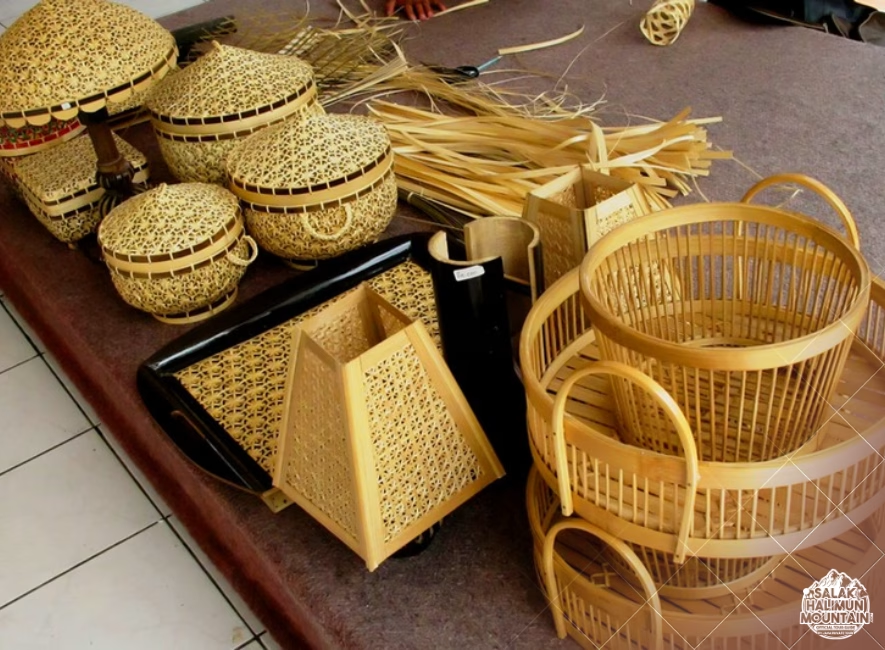
Beyond massive structural architecture, the nimble fingers of Salak artisans transform bamboo into an endless array of functional, everyday items that define highland domestic life. Walking into a traditional kitchen, one is surrounded by a beautiful collection of woven utility. Food is prepared and stored in boboko (sturdy, woven rice baskets), nyiru (flat winnowing trays), and aseupan (conical steaming baskets), each crafted meticulously from ultra-thin bamboo splints.
These household items are highly prized for their durability, lightweight nature, and natural resistance to the humid mountain air. Because bamboo possesses natural antimicrobial properties, it keeps food fresher for longer periods without the need for artificial refrigeration. The creation of these utensils is a slow, meditative art form passed down from elders to youth during the cool evening hours beneath the traditional verandas, ensuring that the village’s artistic identity and ancestral skills remain vibrantly alive.
A Complete Loop of Sustainability
The systemic lifecycle of traditional bamboo crafts reflects a profound zero-waste ethics that modern sustainability experts deeply admire. The materials require no heavy machinery, factory manufacturing, or fossil-fuel transportation, as the entire processing cycle occurs within a few miles of the forest border using simple hand tools like the golok (traditional machete).
When an item like a woven basket or a piece of wall paneling eventually wears out after decades of loyal service, nothing is thrown away to pollute the local ecosystem. The old bamboo is simply utilized as clean-burning firewood for the traditional kitchen hearth (hawu), or it is crushed down to decompose naturally into organic mulch that sweetens the volcanic soil of the village gardens. This flawless, circular loop ensures that human survival leaves absolutely no toxic footprint or lasting scar on the fragile primary wilderness of the national park.
Lessons for the Mindful Traveler: Carrying the Wisdom Down
For the modern backpacker, trail runner, or cultural researcher journeying through the misty heights of Mount Salak, encountering traditional bamboo craftsmanship is a transformative experience. In an era dominated by mass-produced plastics and disposable consumer goods, the quiet ingenuity of these highland villages stands as living proof that true utility and architectural resilience can be achieved in perfect harmony with nature. It challenges us to reflect deeply on our own material consumption and environmental footprint.
As responsible travelers, we can actively support the preservation of this incredible heritage by choosing to stay in authentic village homestays built from traditional materials, purchasing beautifully hand-woven crafts directly from local artisans, and respecting the cultural etiquette of the communities. By sharing the inspiring stories of these bamboo masters, we help provide a sustainable economic incentive for the younger generations to maintain their ancestral skills, ensuring that the living culture of Halimun Salak remains protected for generations to come. Walk softly across the ridges, honor the craftsmen, and let the balance of the mountain transform your journey.
So, if you’re ready to explore the wonders of Mount Salak Halimun, head over to our ONLINE BOOKING PAGE and let’s start planning your adventure. Or simply CLICK THIS LINK to chat with us on WhatsApp.
With our team, you’re not just getting a guide; you’re gaining a local friend who will ensure your trip is nothing short of extraordinary.